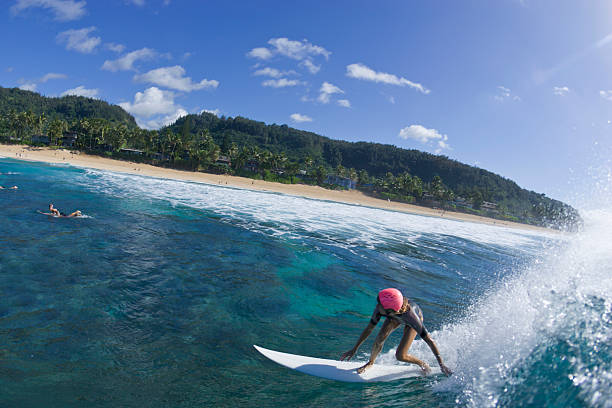
You paddle out on a crisp dawn glass-off, the water like black silk under a butter-yellow sun, and you feel that familiar hum through the deck of your board. The planing hull catches the first bump of a long, slow ground swell and you’re up, trimming across the face with that effortless, free-feeling glide. That feeling, that magic of a ride that unlocks speed without needing a steep drop, owes a serious debt to a man who shaped in the shadows of California back when baggies were still wool and the idea of a fin was still being debated. We’re talking about Bob Simmons, maybe not a household name like the big factory guys, but absolutely a board builder who changed everything we know about riding a wave.
Simmons was a mathematician and engineer who brought a whole different kind of brain to the shaping bays of the late 40s and early 50s. While most shapers were still working with heavy balsa and rocker-less planks designed primarily for nose riding and straight-line speed, Simmons was doing calculations. He was thinking about hydrodynamics, about lift, about the science of how a board interacts with the water column. He didn’t care about style points. He cared about efficiency. The man was on a quest to unlock the ultimate glide, and he did it with materials that felt like heresy at the time. He was one of the first to seriously experiment with foam and plywood composites, turning his nose up at the pristine balsa that everyone else worshipped. He’d glass in a strip of plywood stringer down the center of a polyurethane core, creating boards that were lighter, stronger, and cheaper to produce than anything else in the water. But the real magic wasn’t just the materials.
Simmons’s most radical contribution was the “Simmons Hull.” He took the basic idea of a planing hull from racing boats and applied it to a surfboard. The result was a board that was unbelievably flat and wide in the nose, with a dramatic, hard, rolled rail that dropped off into a relatively thin, rounded tail. The bottom didn’t have the deep concave or the pronounced vee that we see today. Instead, it had a subtle, rockered-out bottom that was more like a smooth, continuous curve. When that board hit a wave, it didn’t just slide. It locked in and accelerated in a way that seemed to break the rules of the day. He gave the water a way to escape over the rails, creating a vacuum of lift underneath the board. Riders felt it, but they couldn’t really explain it for years.
The man was a character, too. A bit of a hermit, a bit of a mystic of the surf world. He shaped in a shed near the ocean in La Jolla, often working with a seagull on his shoulder. He didn’t chase fame or fortune. He chased the perfect equation. And while his boards were fast, they were also notoriously difficult to handle for the average surfer. They were squirrelly, had a mind of their own, and could spin out on a dime if you didn’t know exactly where to put your weight. The top surfers of the day, guys like the legendary Tom Blake and the early Waikiki crew, saw the speed but were a bit skeptical of the control. It took decades for the rest of the shaping world to catch up to what Simmons had already figured out.
Fast forward through the shortboard revolution and the thruster evolution, and you’ve got a whole new generation of shapers going back to the well. Guys like Maurice Cole in Australia and a handful of California builders have been revitalizing Simmons’s soul, taking his hull concepts and merging them with modern materials and foil-ing techniques. They’re not just copying his old templates. They’re understanding his math. They’re realizing that the “Simmons Hull” offers a unique kind of surfing experience, especially for smaller, mushy waves. It’s a board that gets you into the wave incredibly early, gives you that weird, satisfying hum of acceleration without you having to pump aggressively, and allows for deep, drawn-out turns that feel like you’re carving through butter.
Bob Simmons died tragically young, paddling out alone and never coming back. He left behind a relatively small number of boards, but his legacy is a blueprint for how we think about speed, lift, and the fundamental relationship between a piece of foam and the ocean. He didn’t just build a board. He built a philosophy of wave riding that prioritized glide above all else. So next time you catch that outside set and feel that effortless drive under your feet, maybe give a quiet nod to the mathematician in the shed who saw the future of surfing in a plane of flat foam and a hard, rolled rail. He was a true board builder, a soul shaper who carved his name into the water itself.