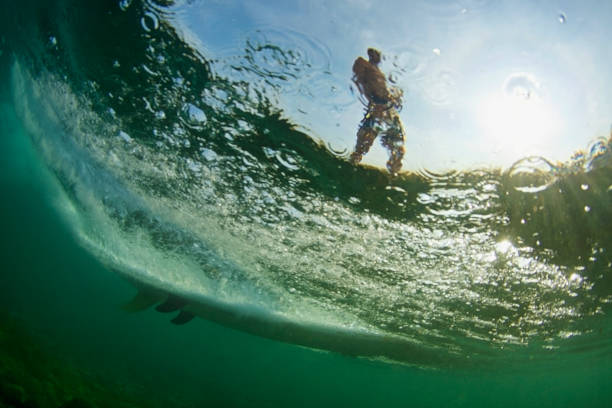
When the ocean decides it’s your turn to get acquainted with the foam, there’s no fighting it. You’re committed, the wave throws its shoulder, and suddenly you’re airborne, inverted, or getting rag-dolled in the rinse cycle. But here’s the thing about surfing: a wipeout isn’t a failure. It’s a rite of passage, a badge of honor, and a vocabulary lesson all in one. Every surfer from Malibu to Mundaka has their own name for the glorious chaos of eating it, and knowing that lingo is half the battle of keeping your cool when the sea turns you into a human washing machine.
Let’s start with the classic pearl. That’s when your nose digs into the water and you tomahawk over the front of your board straight into the deep blue. It usually happens when you take off too steep or you’re late on a drop, and the ocean just yanks the plug out from underneath you. You don’t even get a chance to think. One second you’re standing tall, the next you’re doing a backwards somersault with the rail of your board flirting with your skull. Pearl is a humble teacher. It reminds you to look where you want to go, not at the fins.
Then there’s the washing machine, which is exactly what it sounds like. You get caught inside on a set, or you snap your leash, or you blow a critical section, and suddenly the ocean decides to tumble you like a sock in a dryer. No up, no down, no air in your lungs just a furious mix of whitewater, sand, and your own disoriented limbs. The washing machine doesn’t care about your style points. It just spins you until it’s good and ready to spit you back out. The trick is to stay relaxed, curl into a ball, and let the chaos do its thing. Fighting it only makes you more dizzy.
Speaking of ragdoll, that’s the wipeout where your arms and legs go every which way like a marionette with a drunk puppeteer. You’ve lost all control, your body is just a limp sack of joints bouncing off the water’s surface. It looks ridiculous, feels humiliating, but for the crew watching from the shoulder, it’s pure comedy gold. A proper ragdoll is almost artistic in its awkwardness. You just have to laugh, swim back out, and try to pretend you meant to do that.
If you’re unlucky enough to snap your board, you might get introduced to the tombstone. That’s when your broken surfboard or your lost board sticks straight up out of the water, bobbing like a grave marker for your dignity. The tombstone is a sad sight, but it’s also a reminder that wipeouts have consequences beyond the sting of the salt in your nose. You paddle in with your leash dragging a splintered hull, and you know you’ve earned a repair bill and a story.
For the barrel hunters out there, there’s nothing quite like the pit wipeout. You’re tucked inside the green room, the spit’s building, and for one glorious second you think you’ve made it. Then the lip clamps down like a pair of giant jaws and you’re vaporized. The pit wipeout is a special kind of violence. It flips you over the falls, slams you against the sandbar, and then holds you down while the entire wave piles on top of you. Some surfers chase that feeling. They call it “getting shacked” right up until the moment it turns into “getting slaughtered.“ The pit wipeout isn’t about survival. It’s about surrender. You have to let the wave have its way with you, and then you pop up gasping with a huge grin because you were just inside the beast.
And let’s not forget the humble slide-and-smack. This is the wipeout you see on beginners when they get too far forward and the board just stops. You frontside slide across the wax like a seal on ice, then the rail catches and you smack flat onto the water belly-first. It stings, but it’s also the most forgiving wipeout in the book. No orbital washing machine, no undersea gymnastics. Just a good old-fashioned slapping.
Every wipeout has its own rhythm, its own lesson, and its own name. You’ll hear old salts toss out “mowing the lawn” for the slow, grinding fall where you lazily cartwheel down the face. Or “the elevator” for that creepy feeling when the wave sucks you upward before dropping you into a freefall. The lingo grows as we grow, each generation adding a new flavor of disaster to the dictionary.
The most important thing to remember is that wiping out is not the opposite of surfing. It’s the very core of it. You can’t charge without eating it. You can’t make the drop without pearl-ing a few times first. The ocean is a tough teacher, but she always gives you another chance. So next time you find yourself upside down in a washing machine with sand in your shorts, just smile, take a breath, and remember you just added a new word to your vocabulary. Stoke doesn’t come from standing tall. It comes from laughing every time you fall.