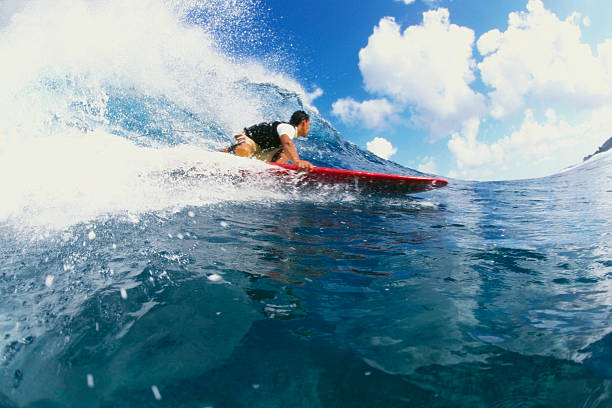
Dawn patrol at your local break. Glassy lines roll in from the deep blue, and you’re sitting out the back with a handful of other souls, all of us chasing that same fleeting moment of glide. The water’s cold, the air is still, and for a few hours, the world makes sense. But then a set rolls in. Three heads swivel. Paddles dig in. And suddenly the lineup gets tense. This is the moment where surf etiquette either makes or breaks the session. It isn’t written on any sign, no lifeguard blows a whistle for it, but these unwritten rules are the glue that holds the surfing tribe together. And at the heart of every single rule lies a simple truth: respect the ocean, and respect the people who share it with you.
The cardinal rule, the one that gets shouted about louder than any other, is the rule of the drop-in. That wave is not yours until you have earned the right to take it. The surfer closest to the peak, the one who paddled deepest and stood first, has priority. If you paddle for that same wave from the shoulder, you are dropping in on them. It is the fastest way to earn a stink eye, a shout across the water, or worse, a fistful of fiberglass to the head. In some lineups, a single drop-in can earn you a reputation that takes years to shake. It’s not just about being polite; it’s about safety. Two surfers on the same wave at speed is a collision waiting to happen, especially when one is dropping from behind and has no idea the other is already riding. So watch the peak. Let the person with position go. If you’re unsure, paddle high, sit deep, and watch how the locals move. The ocean provides enough waves for everyone, just not all at once.
Snaking, or back-paddling, is another subtle but deeply annoying breach of etiquette. This is when you paddle around a surfer who has position on you, cutting them off just as the wave arrives, claiming priority through stealth rather than merit. It’s the surfing equivalent of cutting in line. The lineup is a social ecosystem built on shared observation. Everyone sees who was sitting deepest, who let the last one go, and who is hungry for a score. When you snake someone, you break that trust. You might get away with it once, but the next time a good set comes, you’ll find yourself suddenly blocked, faded, or given the cold shoulder. The best surfers in the world, the ones who truly understand the spirit of the sport, practice patience. They let the set pass, take the inside bowl, and wait for the next pulse. Good waves always come to those who wait with a clear conscience.
Then there is the matter of the lineup hierarchy. Every break has its own social order, based on skill, tenure, and local connection. You do not paddle straight to the main peak at a world-class reef and start calling waves like you own the joint. You sit wide, you watch, you learn who the locals are, and you take your scraps with a smile. Respect the locals. They put in the time when the swell was flat and the wind was howling. They know where the rocks are, what the tide does, and how to read a backwash. That knowledge is currency. If you paddle in humble and show respect, you’ll be welcomed. If you act like a kook, dropping in on everyone and paddling like a blind seal, you’ll spend your entire session getting burned, faded, and frustrated. The old saying holds true: locals don’t owe you a wave, but if you’re respectful, they might give you one anyway.
Beyond these social rules, respecting the ocean itself is the deepest form of etiquette. The ocean is not a swimming pool, and it is not your enemy. It is a living, breathing force that demands attention. Do not paddle out in conditions beyond your skill. Do not put yourself in a position where you need to be saved, because that rescue puts others at risk. Know your limits. Read the forecast. Understand the rip currents, the reef passes, the sneaker sets that sweep through every twenty minutes. When you are out there, take nothing but photographs, leave nothing but footprints, and that goes double for the lineups of your favorite spots. Trash on the beach ends up in the water. Plastic bags look like jellyfish. The turtles, the seals, the fish—they are part of the same wave we ride. So pick up a piece of driftwood. Carry a bag for stray wrappers. It’s not a chore; it’s thanks for giving us the stoke.
And finally, share the stoke. If you catch a gem of a wave, a perfect grinding barrel or a long, rippable wall, do not hoot and then paddle back to the peak and take the very next wave. Let someone else in. Smile at the kid on the foamie who just rode his first green wave. Give a tip to the traveler who is clearly lost. The ocean is an endless classroom, and every surfer, from the grom popping their first floater to the salt-weathered soul surfer who has been riding since the sixties, is a student. When we respect the ocean, we respect each other. And when we respect each other, the magic happens. The lineup becomes a temple, the waves become a prayer, and every session, whether waist high or triple overhead, becomes part of the endless summer that lives inside every surfer’s heart.