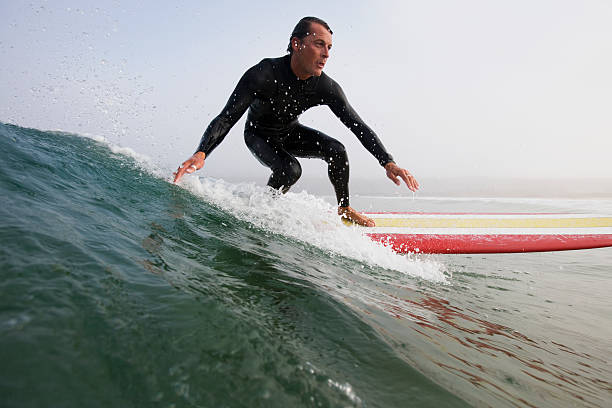
There’s a certain kind of wave rider who doesn’t just surf the ocean—they inhabit a different dimension of it. Miki Dora was that guy. Known as the Black Knight of Malibu, he was the original maverick, a phantom who paddled out on his own terms, rode waves with a style that broke all the rules, and then vanished into the mist just when the world thought it had him figured out. To this day, his ghost still lingers in the lineup, a reminder that surfing is not just a sport or a business—it’s a solitary dance with the sea.
Dora came of age in the 1950s and 60s, when surfing was exploding into the mainstream. While the Gidget movies and the Beach Boys were selling a sanitized version of surf culture, Miki was the real deal—a rebel who saw the waves as his private sanctuary. He never competed in the big contests, never shook hands with the sponsors. He didn’t need to. His board was his signature, his wave count his trophy. He’d show up at dawn, when the water was glassy and the only company was the pelicans, and he’d glide across the face of a wave with a languid, almost dismissive grace. His trademark stance—a slight crouch, one hand trailing in the water, head cocked as if he was listening to a secret—became the stuff of legend. That stance wasn’t just about balance; it was a statement. He was saying, I’m here, but I’m not here for you.
What set Miki apart was not just his skill but his attitude. He had a deep distrust of the surf industry that was turning his beloved ocean into a sales pitch. He saw the billboards, the contests, the branded boardshorts, and he wanted none of it. He’d rather paddle out alone, catch a few perfect waves, and then disappear into the hills of Topanga or the back alleys of Santa Monica. He was a drifter, a charmer, a con man in the best sense of the word—he conned the world into believing that surfing could remain pure. And he lived that lie with such conviction that it became truth for those who watched him. He was the anti-hero of the era, the shadow that made the sun seem brighter. When Bruce Brown was filming The Endless Summer, he captured the dream of traveling the globe in search of perfect waves. But Miki Dora was already living that dream in reverse—staying put, finding perfection in one break, and letting the world come to him. He turned Malibu into a universe.
His legacy is complicated. Miki Dora was not a hero in the traditional sense. He had his dark side: he was known for stealing, for disappearing on debts, for living a life that skirted the edges of the law. He burned bridges with everyone who tried to get close, and he never apologized for it. But in the water, he was untouchable. He rode Malibu’s Point with a fluidity that made other surfers look like they were fighting the wave. He didn’t fight—he surrendered, and in that surrender, he found freedom. That’s the lesson he left behind: surfing is not about domination, it’s about alignment. You can’t force a wave to give you what you want. You have to become part of its movement, let it carry you where it will. Miki understood that on a cellular level. He didn’t carve turns like a gymnast; he flowed like water, like he was part of the swell itself.
Today, the surf world is full of influencers and pros who hustle for likes and cash. Miki Dora would have laughed at them—or worse, simply ignored them. His spirit lives on in every surfer who paddles out at dawn for no reason other than the feeling of salt on skin, in every kid who shapes their own board in a garage, in every lone figure sitting far outside the pack. He represents the untamed edge of surfing, the part that refuses to be packaged and sold. He is the reminder that the best wave you’ll ever catch is the one nobody else saw. The maverick never wanted to be a symbol, but he became one anyway—a symbol of the restless, lonely pursuit of something that can’t be measured on a scorecard.
So when you paddle out next time, think of Miki. Sit a little farther out. Take a breath. Let the world fade away. That’s the art of surfing alone, and it’s the only art that matters. You might not catch a wave as perfect as his, but you’ll catch a glimpse of the freedom he chased. And maybe, just maybe, you’ll feel his presence—a whisper on the wind, a hint of something wild and free. Because Miki Dora didn’t just surf the waves. He became the wave. And that’s a ride that never ends.