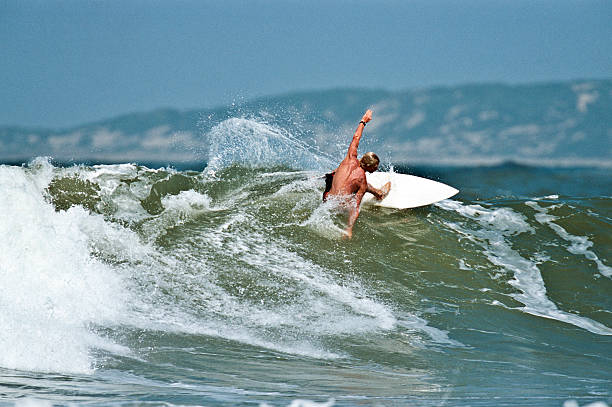
When John John Florence boosts off a heaving North Shore lip, there’s a split second where the sky becomes a ramp. His board leaves the water with a violent yet silky pop, his back hand reaching down to snag the rail, and suddenly time just slows. You see the horizon tilt, the wave below turn into a vertical wall of blue, and for a breath the entire ocean becomes a halfpipe. That airborne moment isn’t just an aerial move. It’s a throwback to every skateboard video that ever burned through his childhood VCR, a pure fusion of two cultures that rarely say thank you to each other but have been trading stoke for decades. John John didn’t just learn to fly in the lineup. He learned to fly on concrete, in a backyard bowl in Haleiwa, where the pavement taught him something the ocean couldn’t: that the air is just another surface to ride.
You gotta understand where this dude came from. Growing up in the shadow of Pipe, John John was a grom with saltwater veins and a skateboard under his arm. The same wave that claimed legends was his playground, but when the flat days hit, he’d shred the transition at a local park, pumping fiberglass and feeling the same kind of rush. That crossover is everything. Skateboarding gave him a physical vocabulary for rotation and grab tricks that pure surfing never offered. The way he tweaks an air, the way he holds a grab mid-spin then seamlessly lands into a bottom turn—that’s straight out of a vert ramp. The indie grab, the lien air, the shifty to fakie—these aren’t just skate tricks. They’re the raw grammar of John John’s aerial mastery, spoken in the language of spray and foam.
Watch any clip of John John torching a wave at Teahupoo and you’ll see it. He’ll drop in, pump for speed, then plant that fin near the lip with a timing that feels robotic except for the organic steeze in his shoulders. The launch is explosive, like he’s popping wood at a skate contest. Then comes the grab—hand to the board, knees tucked, body coiled like a spring. It’s textbook action, but the feeling is all freesurfing. Old-school aerial legends like Christian Fletcher and Shane Herring were pioneers, no doubt, but their airs were often full pucks, tight rotations, survival mode. John John brought the air into the modern era of flow and power. He made aerials look both massive and casual, like he just decided to step off the wave and walk across the clouds for a second before landing back home.
That skate influence goes deeper than just moves. It’s in his approach to the wave itself. A skateboarder reads a ramp’s transition, studies the tranny, finds the perfect speed to launch beyond the coping. John John reads a wave’s face the same way. He doesn’t just look for the barrel or a section to smash. He sees the potential for boost, for a moment of weightlessness that connects the whitewater and the blue sky. His airs aren’t just showboating; they’re a calculated extension of the wave’s energy. That’s how a skater thinks. When Tony Hawk landed the 900, he didn’t just spin fast; he understood the physics of the ramp, the need for speed, the spot of zero gravity. John John does the same in the ocean, except his ramp is moving, morphing, and collapsing behind him. That’s what separates him from everyone else. He’s a skater who happens to be an absolute waterman, and every aerial he throws is a love letter to both crafts.
The new generation of groms is all over this style now. You see kids frothing at the mere mention of an air reverse, trying to sneak in a grab on their first chunky slabo. They watch John John’s clips on loop and then run to the skatepark to try the same rotation on a mini ramp. That’s the circle of stoke. It started with surfers borrowing from skateboards, and now it’s feeding back, with skaters checking out John John’s water footage for inspiration on style. He’s turned the air into a shared language between the parking lot and the reef, a dialect of steeze that everyone wants to speak. And it all comes back to that pure, simple idea: the ocean is just a skate park you have to paddle into. When John John airs out at Pipe, he’s not just winning heats or collecting clips. He’s showing us that the sky, like the concrete and the salt, is always rideable if you’ve got the flow, the nerve, and the right soundtrack in your head.