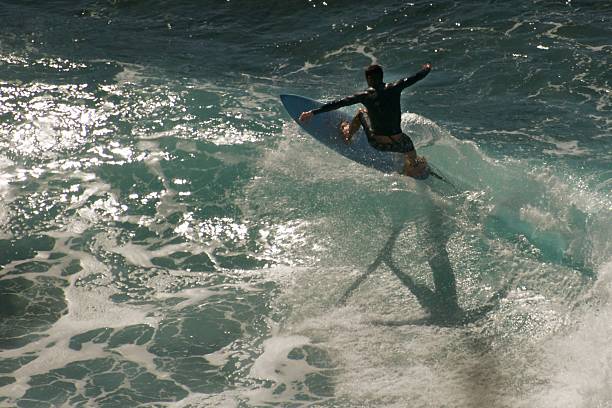
There’s a moment on every dawn patrol at Malibu when the ocean goes quiet, the wind pulls back its teeth, and the first set of the morning rolls in like a long exhale from deep underwater. You paddle out past the lineup of bobbing heads, past the tourists hooting from the sand, past the rail-skaters and the groms with their new thrusters, and you feel it – that familiar pulse. First Point is waking up. The wave is a slow, lumbering, right-hand ribbon that peels off the point at a pace designed for pure style. It’s not the biggest wave you’ll ever ride. It’s not the hollowest. But it is, without argument, the most influential wave in the history of the sport. It’s the place where surfing grew up, got a tan, and never lost its cool.
Malibu’s icon is a point break – a wave that refracts around the rocky headland and wraps into the bay, generating a peeling wall that can run for two hundred yards on a good winter swell. The magic lies in the bottom. Ancient cobblestones and sand shift with every season, sculpting the wave’s shape into a playful, ever-changing canvas. Some days it’s a mushy ankle-slasher, perfect for learning to hang five. Other days, when a northwesterly groundswell meets a low tide and a touch of South Bay bounce, it pitches just enough to give you a critical drop and a hollow section before opening up into that long, walled-out canvas. The locals know these moods like they know the curl of their own toes. They sit in the pecking order, trading waves with a nod and a smile, because at Malibu, aggression gets you nowhere – the wave itself is the teacher, and it rewards patience above power.
Historically, this is the proving ground where the longboard was reborn. In the 1950s, before the shortboard revolution, guys like Mickey Dora and Miki Dora (same guy, depending on who’s telling the story) and Lance Carson turned First Point into a stage for noseriding ballet. They walked to the tip, hung their toes over the edge, and trimmed down the face with an elegance that made the wave look like a living creature you were dancing with, not a machine you were attacking. The iconic Malibu board – that sleek, pintail longboard with a single fin – was sharpened right here, in the whitewash of the point. And when the shortboard boom hit in the late ’60s, it was Malibu that saw the first tentative steps toward the high-performance surfboard as we know it. The wave’s forgiving face allowed innovators to try new fins, new rails, and new rockers without getting slaughtered. So every time you bottom-turn a modern shortboard, you owe a subtle nod to the cobblestones of Malibu.
But the spot is more than just a wave – it’s a cultural crossroads. The surfers who flock here are a motley tribe: retired pro legends, local rippers who’ve earned their spot through years of early mornings, wide-eyed travelers who’ve driven three hours just for one clean session, and celebrities who make a cameo when the cameras are rolling. There’s an unspoken etiquette that hums through the water like a low frequency. The lineup is a rotating door of stoke, where you give way to the dropped-in, respect your elders, and never try to burn the guy who’s been surfing the same corner for fifty years. Because at Malibu, the wave connects you to something larger – a lineage that stretches back to the ancient Hawaiians who first rode alaia boards, then to the Waikiki beach boys who brought the sport to California, and then to every soul who has ever paddled out here chasing that endless summer feeling.
The vibe on the sand is just as electric. The beach is a living museum of surf culture. Vintage boards lean against the lifeguard tower like old friends. The smell of coconut wax mixes with morning coffee. And the sunset session, when the sun turns the water into hammered gold, is a ritual that borders on religion. You’ll see loggers doing hang-ten to the inside, a couple of kneeboarders from the old school, and maybe a tandem duo trying to impress the beach crowd. It’s all part of the Malibu mosaic – a place where the past and present ride the same peeling shoulder, and where every surfer, from the first-timer to the grizzled vet, shares a single, simple truth: you don’t conquer Malibu. You just get to be part of its wave.
So when you paddle out, don’t expect perfection. Expect a crowd. Expect a few drop-ins and a few hard-earned waves. But also expect that rare, transcendent ride – the one that feels like the ocean is carrying you down a path lit by all the surfers who came before. That’s the gift of this classic point break. It never asks for your résumé. It just asks for your stoke. And if you give it that, Malibu will always, always give you something back.