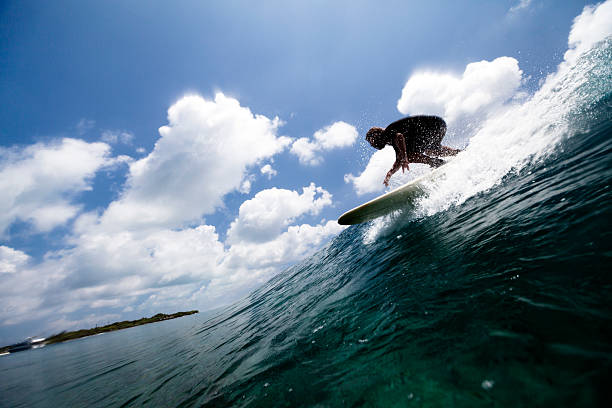
Ask most groms today about surf culture and they’ll talk about the Instagram reel, the sharp and tight lineup at some world tour event, or the newest pyralite thruster fin. They’ll tell you it’s about the speed, the hollower wave, the barrel count. And sure, that’s part of it. But true surf culture—the kind Beyond the Ride that stays with you long after your arms feel like wet rope—was built by a quiet few who weren’t even riding the biggest waves. Men like Thomas Blake. You probably know him as the kook who showed up in Hawaii with a hollow board that sank swim test after swim test. But think about that for a second. If you were in the lineup in 1926 and saw some mainlander paddling out on a thing that looked like a cigar box, you might shake your head. But Tom Blake didn’t just change the shape of the surfboard. He changed the vibe. He defined what it means to chase the soul.
Blake was a true waterman before that term got attached to every Instagram surf coach who can do one spin on a longboard. He was an orphan, a lifeguard, a museum guard, and an innovator. He was one of the first people to ever glass in a wooden board using varnish and canvas—effectively inventing the sealed hollow board that would lead to the light, buoyant shapes we ride today. That alone puts him in the surf history hall of fame. But the real legacy is what he did with that board. He didn’t just ride it. He photographed it. He documented the lineup, the palm trees, the shadows of waves at Waikīkī. He built the first waterproof camera housing and then paddled out to shoot surfing from the inside. Before Blake, surf photography was a postcard. After Blake, it was a window into a life lived entirely on the face of the ocean.
And here’s where the culture part kicks in, beyond just the ride. Blake was the first to argue that surfing wasn’t just about the speed going down the line but about the feeling of being inside the curve. He wrote about the spirit of the motion, the way a wave has its own energy and you get to borrow it for ten seconds. He published a book called The Surfing Guide and later Hawaiian Surfriders, which was the first real history of the sport. That’s the kind of stoke that doesn’t come from slinging a board in the back of a van and chasing a swell. That kind of stoke comes from sitting on the sand between sessions and asking why this all matters.
Blake also invented the first fin. He glued a metal skeg onto a board back when everyone thought they were surfing sideways because they just were, and nobody complained. That single change let surfers turn with control, hold a line, and truly carve the face of the wave. It’s the backbone of modern surfing. But again, think beyond the ride. That fin changed the social structure of the lineup because you could suddenly drop in more precisely, cut back, stay with the wave longer. It changed the relationship between surfer and wave from a straight line to a conversation. That’s culture. It’s the result of one guy thinking not just how do I go faster but how do I feel more connected.
That’s the lesson of Tom Blake for the modern surfer who’s worried about their Insta clips or the right wetsuit temperature rating. Culture is what you bring back from the water. It’s the sand in the truck. It’s the stories you tell at dawn when the coffee’s too hot and the swell’s too small to matter but you’re there anyway. Blake understood the chase wasn’t about the biggest wave ever ridden, but about the biggest wave you could hold inside yourself. He lived simple, slept on the beach, built boards by hand, and he documented the whole thing because he knew it was something worth passing along.
When you paddle out tomorrow, remember that fin under your tail and the camera in your head, and the quiet soul of a man who knew that surfing was never really about the ride at all. It was about the quiet moments after the ride, the sharing, the preserving, and the deep, endless aloha that keeps us returning to the ocean. In chasing the sun, we’re really just chasing the same feeling Tom Blake found in 1926: that the best part of surfing has never been the wave. It’s been the person you become in its wake.