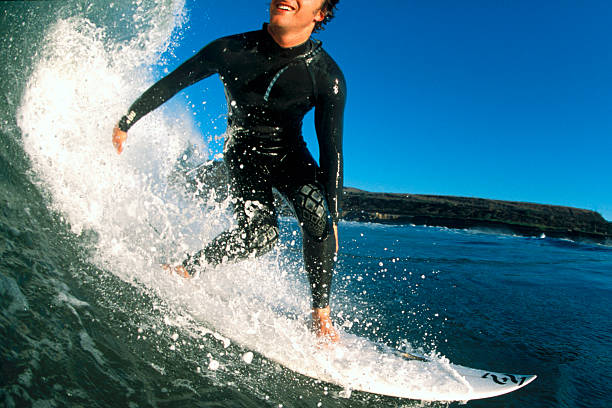
You paddle out past the shorebreak, arms burning, lungs sucking in salt air, and you sit there in the lineup bobbing like a cork, scanning the horizon for that telltale bump of corduroy lines. When it comes—that one set wave with a glassy face—you spin, stroke a couple of hard pulls, feel the board lock in, and you pop to your feet. Now comes the moment that separates the kook from the ripper: the bottom turn. That single carve at the base of the wave isn’t just a turn—it’s the foundation of every move that follows, from a simple cutback to the most radical air. Without a solid bottom turn, you’re just a passenger on a wave, along for the ride but never really in control. With it, you become the wave’s co-pilot, harnessing its energy and redirecting it into a full-blown session of stoke.
The bottom turn is the connective tissue of surfing. Think of it like the downstroke in a paddle stroke or the backswing in a golf swing—it’s the part nobody sees that makes everything else possible. When you drop into a wave, you’re basically falling. Gravity is pulling you straight down the face, and if you do nothing, you’ll either get smashed by the lip or just plow straight to the flats and lose all your speed. The bottom turn is where you take that raw velocity and transform it into something else. You compress down, sink your weight into your heels, and carve a smooth arc that redirects your momentum up the face. The best surfers make it look effortless, but anyone who’s tried knows it’s a delicate dance of weight distribution, rail control, and timing.
There’s a reason why the bottom turn is taught before almost any other maneuver in surf schools and coaching clinics. It’s the first real test of your ability to read a wave. A wave isn’t a static piece of terrain—it’s a living, breathing shape that changes every second. The bottom turn requires you to feel where the wave’s energy is going, to anticipate when it will steepen or flatten, and to commit fully to the turn without hesitation. If you’re late, you’ll get caught in the whitewash. If you’re early, you’ll slide out and lose all drive. It’s a split-second decision that becomes second nature after enough reps, but it never stops being thrilling.
In the rich lingo of surfing, the bottom turn goes by a few different flavors. There’s the “full-rail carve,“ where you bury the inside edge and turn as tight as possible, generating maximum speed for a vertical snap or a big air. There’s the “pump turn,“ a series of subtle rail adjustments that keep you moving across the wave while maintaining momentum. And then there’s the “rail grab bottom turn,“ a more recent addition popularized by the progressive shortboard generation, where you literally grab the rail of your board during the turn to create extra leverage and control. Each variation serves a different purpose, but the core mechanics are the same: compress, lean, and release.
The history of the bottom turn is the history of modern surfing itself. Back in the longboard era of the 1950s and 60s, surfers like Phil Edwards and Mike Doyle were pioneering the idea of turning on a wave, but the boards were so long and heavy that bottom turns were more like slow, wide arcing slides. It wasn’t until Bob Simmons and later the shortboard revolution in the late 1960s with guys like Nat Young and Gerry Lopez that the bottom turn became the dynamic, explosive move we know today. The introduction of the twin-fin and then the thruster setup by Simon Anderson in the early 1980s allowed surfers to really dig in and turn harder than ever before. Suddenly, you could drive the inside rail deep into the wave face and come flying out of the bottom with enough speed to launch into the air.
That connection to aerials is key. The modern air game—from the alley-oop to the frontside air reverse—all starts with a bottom turn that sets the angle and speed. When Kelly Slater first started pulling off airs in the early 1990s, he was essentially doing a very deep, high-speed bottom turn that directed him up and off the lip. The same goes for today’s aerialists like John John Florence or Gabriel Medina. They don’t just float up there blindly; they use the bottom turn to load up the board like a spring, then release at the top. And the move that looks the simplest of all, the duck dive—that underwater plunge to get past the shorebreak—also has a subtle bottom turn element. As you push the nose under and let the wave pass over, you angle your board slightly so you can slide under the turbulence. It’s a microcosm of the same principle.
Beyond technique, the bottom turn has a spiritual dimension in surf culture. It’s the moment when you stop fighting the wave and start flowing with it. Old-school surfers talk about “finding the rhythm” of a wave, and nothing locks you into that rhythm like a well-timed bottom turn. It’s a feeling of compression and release, of being held down by gravity and then flung upward by the wave’s own energy. In the lineup, you’ll hear guys say, “Just stay low and let the turn happen.“ They’re not talking about physics; they’re talking about trust.
So next time you paddle out, pay attention to that move. Whether you’re a beginner just learning to go down the line or a seasoned ripper trying to stick a huge air, the bottom turn is your launchpad. It’s the unglamorous, essential heart of surfing—the thing that turns a drop-in into a dance. Be stoked on the bottom turn, because without it, everything else is just falling.