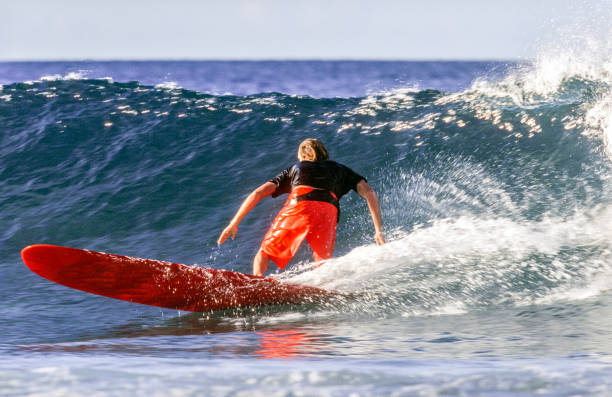
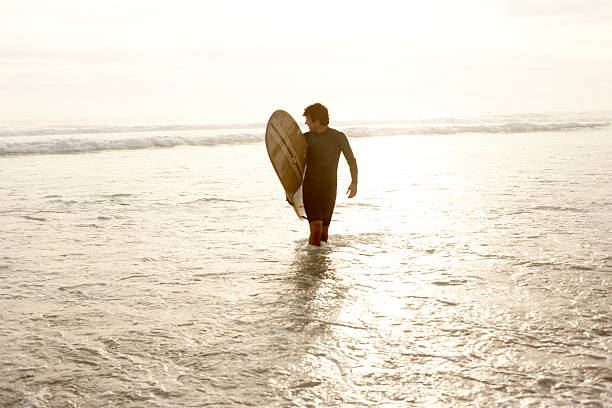
There’s a quiet ritual that happens every dawn at every break worth its salt. You pull up to the lot, step out of the van, coffee in hand, and you don’t just sprint to the water like a dog off a leash. You stop. You stand there, feet planted in the sand, and you watch. It looks like you’re just staring, maybe daydreaming, but what you’re really doing is reading the ocean’s mood. You’re feeling its pulse. And let me tell you, that moment of stillness before you ever touch salt is one of the most important things you can do if you truly want to respect the ocean.
Too many groms and weekend warriors think the ocean is just a big blue bathtub waiting to be played in. They think it’s all about the wave count, the sick air, the Instagram clip from the shoulder. But the ocean is not a toy. It is not a machine built to serve you waves. It is a living, breathing, wildly powerful force that will humble you in a heartbeat if you come at it with the wrong energy. Respecting the ocean starts before you even paddle out, and it starts with your eyes and your brain, not your arms and your board.
When you stand on the beach and just observe, you are tuning in to the ocean’s rhythm. You are asking it, not demanding it. You watch the sets roll in and you count how many waves are in a group and how long the lulls are between them. That alone tells you if you’re about to get caught inside with no breath left or if you have time to cruise out calm and collected. You feel the wind on your cheeks, you notice if it’s glassy or choppy, and you check the direction of the swell. That information tells you whether the wave is going to pitch open like a dream barrel or just fold over and chop your head off on a shallow reef. If you’re not patient enough to read those signals, you are not respecting the ocean. You are disrespecting its power.
And that sits at the heart of surf etiquette. People think the rules of the lineup are about who has priority, who drops in, who snakes the set, who paddles back out through the impact zone. That’s all true, but it’s surface level. The deepest rule of surf etiquette is understanding that you are a guest in a domain that could end your life in three seconds flat. When you slide into the water, you need to know where the rips are pulling, where the reef is sharp, and where the shorebreak is going to smash you into the sand if you get out of position. The ocean doesn’t care that you have a new board or that you drove three hours. It cares about the tides, the wind, the sandbars, and the swell periods. If you don’t read that story before you paddle out, you’re not just being careless. You’re being arrogant, and arrogance out here gets people rescued, or worse.
Another layer of this respect is watching the people already in the water. Before you even put a foot in, take a look at the surfers in the lineup. See where they are sitting, how they are moving, what they are avoiding. If you see a crew sitting wide and tight to a channel, maybe there’s a rip current moving through the pack that you wouldn’t have noticed from the lot. If you see one surfer paddling hard for the shoulder while others are sitting deep, maybe a sneaker set is on its way. The experienced surfers in the water are reading the ocean in real time, and you can learn from them before you even get dunked. That’s humility. That’s respect.
The real beauty of this whole thing is that the ocean teaches you a lesson every single time you forget. You can have a million sessions under your belt, and the moment you get lazy, the moment you stop watching before you go, the ocean will remind you. You’ll get caught inside on a twelve-wave set. You’ll get held down long enough to feel the panic creep in. You’ll find yourself in a rip current you didn’t see, your arms burning, your board dragging, and you’ll remember that you should have stood on the beach for five more minutes. The ocean doesn’t hold grudges, but it doesn’t make exceptions either. It is the ultimate equalizer, and it will treat a world champion the same way it treats a first-timer who doesn’t know any better.
Respecting the ocean is not about being afraid of it. It is about being awake to it. It is about recognizing that every moment in the water is a gift, a conversation between you and something far older and bigger than you can imagine. When you stand on the beach and just watch, you are saying, I see you. I hear you. I am ready to listen. That is the highest form of etiquette. That is how you earn the right to be out there. So next time you arrive at the break, park the car, breathe deep, and watch. Let the ocean tell you if it wants company that day. When it does, paddle out humble, and the wave you get will taste sweeter than any hit of salt you’ve ever known.