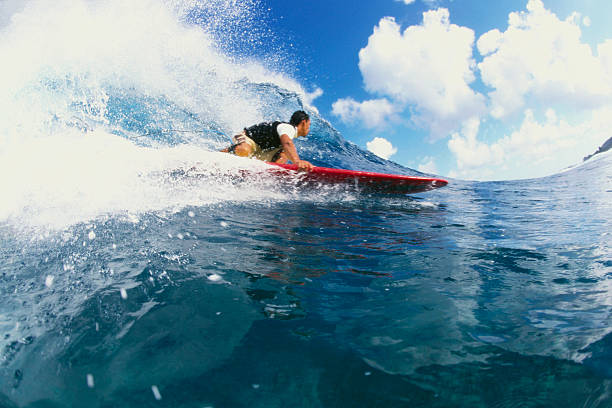
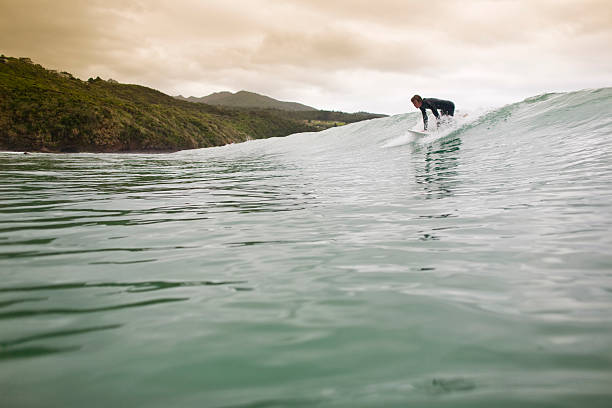
You paddle out on a day that feels wrong from the start. The horizon looks jagged, like a saw blade cutting into the sky. The wind is offshore but howling, and every few seconds you feel the low rumble of something massive shifting underwater. This is not a regular session. This is where the word gnarly earns its keep. Out here, on the outer reef of Peahi on Maui’s North Shore, gnarly ain’t just a word you throw around to describe a closeout barrel or a sketchy drop-in. Gnarly is the whole vibe. It’s the sound of a wave detonating on shallow lava rock. It’s the sight of a sixty-foot wall of water standing up vertical, with no mercy in its eyes. It’s the feeling in your gut when you know you’re in way over your head but you paddle anyway because that’s what you came for.
Jaws is the kind of wave that makes every other big wave break look like a friendly beach break. It breaks over a reef that comes up to meet you like a concrete slab covered in barnacles. The takeoff is not a drop so much as a freefall into a chasm. You don’t surf Jaws so much as you survive it. The crew out there, the heavy hitters like Laird Hamilton, Dave Kalama, and the young guns like Kai Lenny, they have a different relationship with gnarly. For them, gnarly is the standard. It’s not a description of the wave’s mood. It’s the baseline condition. If the wave isn’t trying to kill you, it isn’t worth the tow-in. And that’s the key to understanding gnarly in its most pure and terrifying form. It ain’t just about size. Jaws can be fifty feet and still be mellow compared to a forty-foot day with the wrong swell direction and an incoming tide. Gnarly is about consequence. It’s about the distance between you and the reef. It’s about the current that drags you sideways into the impact zone before you even get a chance to paddle. It’s about the hold-downs that feel like an eternity, where your lungs burn and your ears pop and you start seeing stars before you finally break the surface, gasping for air, and see the next set already jacking up on the horizon.
What makes Jaws so gnarly is the combination of factors that all align at once. The swell comes from the north Pacific, often generated by storms that whip up waves that travel thousands of miles without losing their anger. When that energy hits the shallow reef off Maui, it doesn’t just break. It stands up, pitches forward, and throws a lip that can be as thick as a bus is long. The channel that let you paddle in becomes a washing machine, full of whitewater and foam and the ghosts of skis that got flipped. The crew on the jet skis are the real heroes, because without them, you don’t even get a chance to test your nerve. They tow you into the wave at speeds that feel like you’re strapped to a rocket, and they let go just in time for you to drop into the pit. And once you’re in, you’re alone. The wave owns you. You either make the drop, tuck into the barrel if you’re lucky and stupid enough to try, and then try to kick out before the whole thing collapses on your head, or you don’t. And if you don’t, you get rag-dolled. You get spun in circles underwater with no sense of up or down. You get scraped across the reef. You get a lesson in humility that no amount of surf mag covers can prepare you for.
Gnarly at Jaws is also a mental game. It’s about staying loose when your instincts are screaming at you to run. It’s about trusting your equipment, your ski driver, and your own ability to make decisions in split seconds. The guys who charge Jaws regularly have a calm about them that borders on the supernatural. They don’t freak out. They don’t yell. They just watch the sets, read the ocean, and pick their moment. That’s the essence of gnarly. It’s not just the physical extreme. It’s the psychological edge that separates those who belong out there from those who are just visiting. If you’re on Jaws and you feel scared, you’re normal. If you’re on Jaws and you feel nothing, you’re lying or you’re not paying attention. The gnarly factor is the respect you give the wave, the humility you carry in your heart, and the quiet acknowledgment that you are small and the ocean is big. And that’s the truth.
So the next time you hear someone call a wave gnarly, ask them if they’ve ever sat on a ski at Peahi as a set looms on the horizon. Ask them if they’ve ever felt the reef beneath their fins when they’ve been held down too long. Real gnarly isn’t a word. It’s a place. And that place is Jaws.