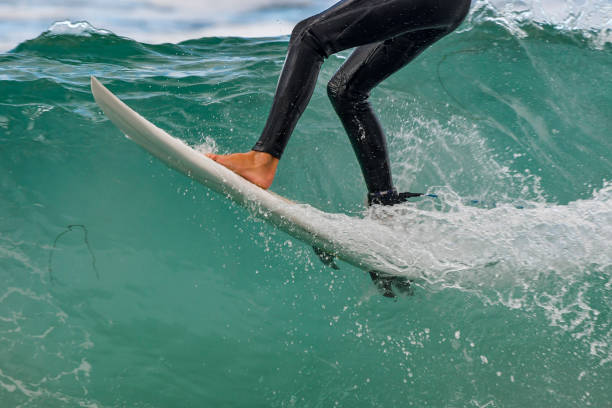
The first time you walk a longboard to the nose, something shifts inside. It’s not just a move, not a trick to check off a list. It’s a conversation with the ocean, a whisper of the old ways. Hanging ten – all toes curled over the nose, head over the water, arms out like a tightrope walker – is the ultimate expression of the longboard era. It’s where surf craft meets pure soul.
Before the shortboard revolution turned surfing into gymnastics, boards were heavy slabs of redwood. You carried them like a cross, paddling with the grace of a slow dance. The ancient olo and alaia boards were reserved for Hawaiian royalty. But post-war California birthed the hang ten we know. Guys like Dewey Weber and Mickey Dora composed poetry on the face. They found that walking forward shifted weight to the tip, letting the wave hold them in a trance-like glide. The skeg, a small fin added in the 1930s, made that walk possible. Without it, the board would spin out.
To hang ten, you need more than balance. You need trust. The wave gives you a platform – a clean, glassy face, preferably waist-high and peeling slow. You stroke in early, the steepest part still forming ahead of you. As you reach your feet, you start trimming, that sweet spot where the board feels like it’s riding on a rail made of silk. Then comes the walk. Short, shuffling steps, toe to heel, toe to heel, while your eyes stay locked on the horizon. You don’t look down – that’s a rookie move. You let your feet find the stringer, the central line of the board, and you keep moving until your ten toes drape over the nose, kissing the foam. The water rushes beneath you, six inches away from your face. The spray from the nose parts like a curtain. For a few eternal seconds, you become part of the wave’s energy, not a rider but an extension of its pulse.
The culture around hang ten is as laid-back as the maneuver appears. It’s not about hucking yourself into the air or slamming the lip. It’s about flow, about matching your rhythm to the ocean’s. Longboarders have always had a different vibe in the water. They sit further out, catch waves earlier, and when they hang ten, they do it with a subtle grin that says, “Yeah, I’ve been here before.“ The late 1960s and early 1970s saw the longboard’s fall from grace as surfers favored shorter boards for more radical turns. But the hang ten never fully died. It survived in the Waikiki beach boys, in the nose riders of Australia’s Bells Beach, and eventually in the longboarding revival of the 1980s and 90s. Today, it’s a staple of any session where the swell is small and the vibes are high.
What makes hang ten special is that it demands nothing but a gentle slope. No hollow barrels, no steep drops, just a rolling shoulder and a willingness to commit. It teaches patience – you can’t rush the walk. Too fast, you stall and faceplant. Too slow, you miss the pocket. There’s a fine line between chaos and grace, and finding it is a lifelong journey. Every wave is different, every board responds differently. Some boards want tiny shuffling steps, others allow a confident stride. The best ones feel alive under your feet, guiding you to the nose as if it’s the most natural thing on earth.
In the end, hanging ten is less about a physical achievement and more about a state of mind. It’s the longboard’s answer to the question, “What does surfing feel like?“ It feels like walking on water, like you’ve tapped into something ancient and essential. The old Hawaiian kings knew it. The California soul surfers knew it. And any grom who’s ever stepped onto a nine-foot log and felt that first lift of the nose understands it. The dance with destiny isn’t about conquering the wave – it’s about joining it, toe by toe, breath by breath, until there’s no difference between you and the sea. It’s the kind of feeling that makes you paddle back out for one more wave.