Aloha, little rippers. So you just got your first foamie, you’re paddling out past the shorebreak, and suddenly you hear a crew of older dudes yelling stuff like “Go left off the peak!” or “Don’t snake that set, brah!” You nod like you get it, but inside your head it’s all static. No sweat. Every grom has been there. Surfing has its own language, a mix of old Hawaiian words, classic surfer slang, and new-school chatter that shifts faster than a sandbar. Learning the lingo isn’t just about sounding rad – it’s about staying safe, showing respect in the lineup, and connecting with the stoke that ties everyone together out on the water. So grab your stick, slap on some wax, and get ready to decode the salty tongue of wave riders.
First up, the basics. Your surfboard is your stick, your plank, or your sled. If you ride a longboard, you’re on a log or a cruiser. A shortboard is a potato chip or a fish, depending on the shape. When you paddle out, you head through the whitewater – that sudsy soup after a wave crashes – and into the lineup, which is the designated spot where surfers sit and wait for sets. A set is a group of larger waves rolling in on a rhythm. If someone yells “Outside!” that means a big set is approaching, and you better paddle hard or duck dive deep. Duck dive is when you push your board underwater nose-first to slip under a wave. On a foamie, you might have to do a turtle roll instead – flipping over with your board and hanging on while the wave washes over you.
Now, the conversation. When you’re talking about waves, the peak is the highest point of the breaking wave, and it’s where you want to be. “Left” and “right” describe which direction the wave breaks from your perspective as you ride it. A barrel – also called a tube or a pit – is the hollow space inside a wave when it curls over. Getting barreled is the ultimate rush, but groms need to be patient; barrels come with time. A closeout happens when the entire wave breaks at once, leaving no room for a ride. A crumbly wave is soft and mushy, perfect for beginners. A glassy wave is smooth and clean, often early in the morning when the wind is low. Onshore winds chop things up, but offshore winds groom the wave face, making it hold up longer.
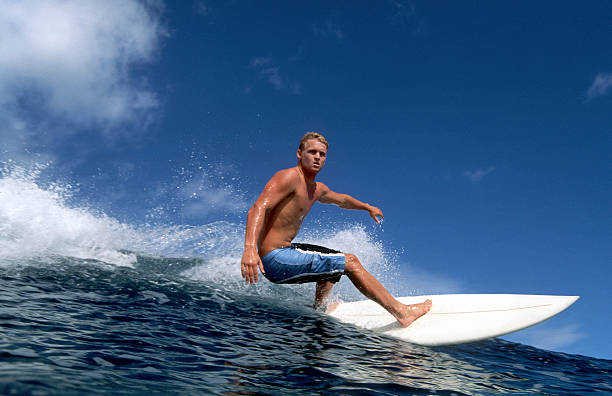
You’ll also hear terms about your skills. Shredding means carving hard and doing turns. A cutback is a sharp turn back toward the whitewater. A bottom turn is the first big turn at the bottom of the wave to generate speed for your next move. Hanging ten is a longboard move where you walk to the nose and both toes hang off the front. That’s the classic style of the old dudes who smile a lot. Kook is the opposite of a shredder – it means a clueless surfer who drops in on others, paddles against the rules, or acts like a jerk in the water. Don’t be a kook. Be a grom who learns proper lineup etiquette: one surfer per wave, the closest to the peak gets priority, and never snake someone’s wave.
Then there’s the vibe. Stoke is the pure joy of surfing. When you catch a clean ride and feel your board hum across the face, that’s full stoke. You can also say you’re amped or frothing to describe wanting to surf really badly. “I’m frothing for that swell next week.” “Swell” is the system of waves generated by distant storms, and it can be measured in feet, though old surfers might use their hands to make up a size. A “shoulder-high” wave is roughly chest to head height at your local break. If conditions are firing, that means the waves are excellent. If it’s flat, there’s nothing – so you might as well wax a board or practice pop-ups on the sand.
Finally, the culture. Say “shaka” – that’s the hang loose sign with your thumb and pinky out. It means hello, goodbye, thanks, and right on. Call your friends “brah” or “cuz.” When a surfer says “cowabunga,” they’re channeling pure old-school cartoon energy, but it still works. Respect the ocean and its power. Every high tide and rip current tells you something. Watch the locals. Learn their names. They’ll appreciate that you tried to talk the talk, but more importantly, that you walk the walk – paddling hard, respecting the rules, and always sharing waves.
Keep it simple. Start with a few terms each session. Add new ones when you hear them. Ask – surfers love talking about surfing. Soon enough you’ll be dropping into shoulder-high peelers, calling your friends for the next set, and laughing about that closeout that smoked your last ride. The ocean is your classroom, and the lingo is your passport. So go grab your board, paddle out, and say “Howzit?” to the crew. The stoke is everywhere. You just need to know the words to catch it.