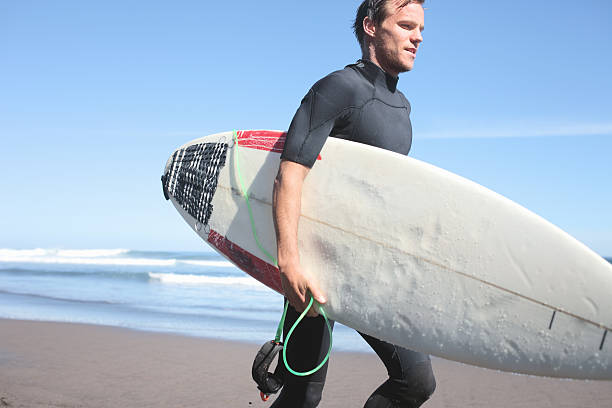
There you are, paddling out at a spot that’s a little bit of a grinder. The sets are stacking up fast, the rip is trying to drag you down the coast, and you’re about to grab the first wave of the session. You take off, bottom turn hard, and just as you’re about to hit the lip, the wave pitches out a little too far. The board slips. You get pitched into the washing machine, rag-dolled for a second, and when you come up sputtering, there it is—your stick, bobbing a few feet away, held by that thin, black, rubbery cord. You grab the rail, hop back on, and paddle back out, talking to yourself about how close you came to losing your board. That cord, brother, is the leash. It’s not the flashiest piece of gear in your bag, and nobody ever put a sticker on a leash, but it is the first line of defense between a good session and a long, sad swim to the beach.
Back in the day, before the leash was invented, surfers lived a different life. If you wiped out, you swam. And you swam hard. If the current was ripping, you might have watched your custom shaped board, your only board, disappear into the horizon. The old-school chargers had to be better swimmers than they were surfers. The leash changed everything. Pat Curren is credited with pioneering the modern leg rope in the late 1960s and early 70s, using surgical tubing and a nylon cord. The idea was met with resistance at first. Some purists thought it was cheating or unsafe. They said it would make you lazy or tangle you up. But the practicality of not losing a board worth a week’s wages won out. By the late 70s, the leash was standard issue, and it opened up the door for modern high-performance surfing. You couldn’t try a full rotation air or a deep, late drop-in without knowing your ride was coming back to you.
The modern leash is a masterpiece of simple engineering. It’s your safety net, your anchor, and your insurance policy all rolled into one. The standard leash has three main parts: the cuff that goes around your ankle or calf, the cord itself, and the rail saver that attaches to your board. The cord is almost always made of polyurethane, which is stretchy and durable. That stretch is key. A leash that is too rigid will yank back on your ankle with brutal force, and it can actually snap your board back at you like a whip. A good leash stretches, absorbing the energy of the wave and the pull of the board, giving you a soft, gentle tug instead of a violent jerk. This is why the cheap, stiff leashes you find at the drugstore are not worth the plastic they are made of. A good leash from a company like Creatures of Leisure, Dakine, or FCS will have a variable thickness in the cord and a quality swivel at both ends to keep the thing from getting twisted up like a tangled earphone cable.
There is no one-size-fits-all leash. You need to think about where you surf. If you are out at a soft, mellow point break in waist-high waves, a thin, light leash is fine. It cuts through the water better and offers less drag when you’re paddling. But if you are charging a heavy, hollow reef or a big beach break like Pipeline or Teahupo’o, you need a heavy-duty leash. Those are thicker, sometimes with a double swivel, and they are designed to withstand a massive beating. You also have to consider the length. You want a leash that is roughly the same length as your board or a little shorter. A leash that is too long will drag in the water and create drag, and it can also flop around and hit you in the face. A leash that is too short will yank your board right into your back when you fall, which is a good way to get a fin in the kidney. For a standard shortboard, a six-foot leash is the sweet spot. For a longboard, you go a little longer.
One thing every surfer knows is the feeling of the leash pulling. It’s a distinct resistance. You feel it when you are kicking for a wave and the tail of the board is pushing against the water. You feel it when you’re paddling out through whitewater and the cord is dragging behind you. But you also feel it when you’re about to get caught inside. That gentle pull on your ankle reminds you that you need to get through the next wave. It’s a literal connection between you and your ride. And there is a certain spiritual quality to that connection. It’s a tether. It binds you to the board, and the board binds you to the wave. That little piece of urethane is the physical link in the chain of the surfing experience.
So next time you are waxing your board, take a second to look at your leash. Check the velcro on the cuff. Make sure it’s not all fuzzy and worn out. Give a little tug on the rail saver to make sure the knot is still tight. A broken leash is one of the most frustrating things in surfing. You lose the wave, you lose your board, and you have to swim a quarter-mile in the shorebreak to chase it down. It’s a buzzkill. Keep your leash dialed in. Keep it washed with fresh water after a surf. Keep it out of the direct sun when you are not using it. It’s a silent servant, a piece of gear that never gets the credit it deserves. It’s the guy on the team who does all the dirty work and never says a word. Respect the leash, and the leash will always bring you back to the lineup.