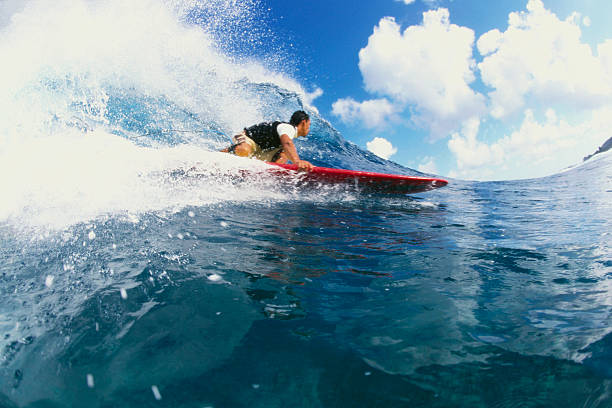
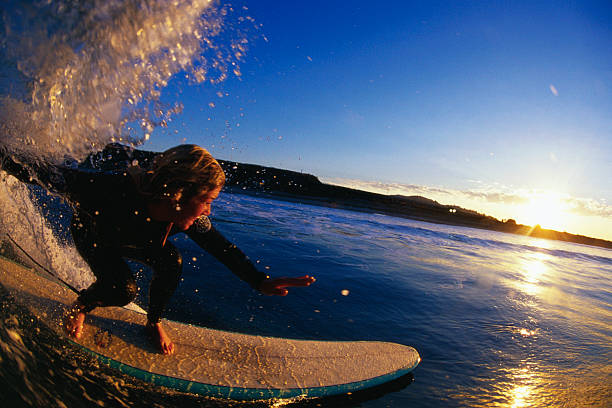
There’s a certain magic that happens when you paddle out past the break and the chaos of the shore melts into the rhythm of the swell. The ocean speaks a language all its own, but we humans have birthed an entire dialect to match it. Surf slang isn’t just about labeling waves and maneuvers, it’s a stoke-infused code that binds the tribe, from the grom on a foamie to the salt-crusted veteran who’s seen more barrels than a liquor store. To truly live the endless summer, you gotta talk the talk while you walk the walk, or in our case, paddle the paddle.
Let’s start with the foundational stuff, the terms that get thrown around from the parking lot to the peak. The “break” is where the wave breaks, but it’s also the vibe of a spot, like “that break is firing.“ A “peak” is the highest point of a wave as it’s about to pitch, the sweet spot where you want to be when you drop in. You don’t just catch a wave, you “paddle in” and “pop up” onto your board. That moment of committing, when you feel the wave lift your tail and you drop down the face, is the “takeoff.“ It’s pure adrenaline, the kind that keeps you coming back for dawn patrol even when the alarm screams at 5 a.m. and the water’s glassy but freezing.
Now, the wave itself has a personality. An “offshore” wind blows from the land out to sea, grooming the face into a smooth, hollow canvas, the stuff of barreling dreams. “Onshore” wind, on the other hand, chops it up into messy, blown-out mush, good for practice maybe, but not for glory. When a wave peels perfectly along a reef or sandbar, you call it a “right” or a “left” depending on which direction you ride. And when it throws out over your head, that’s a “tube” or a “barrel.“ Getting “shacked” or “slotted” inside the green room is the holy grail, the moment where time slows down and you’re just a speck inside a moving mountain of water. If you make it out, you’re on cloud nine. If you get “caught inside” when a set rolls through, you’re taking a beating on the “inside,“ paddling like mad or diving under the whitewater.
The maneuvers are a whole other lexicon. A “cutback” is that stylish turn where you whip back toward the pocket, the power source of the wave. A “snap” is a quick, vertical turn off the top, all blast and spray. A “floater” is when you ride right over the foaming lip, landing back on the face with a sigh of relief. For the longboarders, there’s the “hang ten” and the classic “cross-step” down the nose. We can’t forget the “bottom turn,“ the pivot point that sets up every radical move. And if you’re really ripping, you might throw a “frothy” or a “claim,“ that post-ride fist pump that says, “Yeah, I know I just scored.“
But surf slang ain’t just about the physical act. It’s about the community, the culture, the unspoken rules of the lineup. A “kook” is someone with zero style, dropping in on other people and flailing around. A “grom” is a young shredder full of raw stoke. “Dibs” or “priority” goes to the surfer closest to the peak, and dropping in on someone is a cardinal sin. The “lineup” is the waiting area beyond the break, a floating forum where guys nod at each other and share the silent nod of mutual respect. “Localism” is that territorial vibe some spots get, where the regulars think they own the place. And if you’re “kissed by the ocean,“ you took a gnarly wipeout, maybe got tumbled in the washing machine of whitewater.
Then there’s the pure stoke, the intangible feeling that ties it all together. When the waves are pumping and the sun’s out and you’re sharing a peak with your buddies, that’s “stoke in its purest form.“ “Waxed” means ready to go, but also a good day of riding. “The endless summer” isn’t just a movie, it’s a lifestyle of chasing swell, of living light and free. “Surfing is a way of life,“ we say, and the lingo reflects that. It’s not just about being “amped” or “pumped,“ it’s about the quiet moments sitting on your board, watching the horizon, and knowing that the ocean will always give you something to talk about.
So next time you paddle out, brush up on your glossary. Know your “blown-out waves” from your “glass-off” conditions. Call a “party wave” when you and a friend share a peak, and never forget to say “out” when you kick off your waves. The words are as fluid as the water itself, evolving with each generation, but the core remains the same. Surfing, at its heart, is about connection, and the slang is the glue. Keep it salty, keep it real, and always respect the brotherhood of the break.