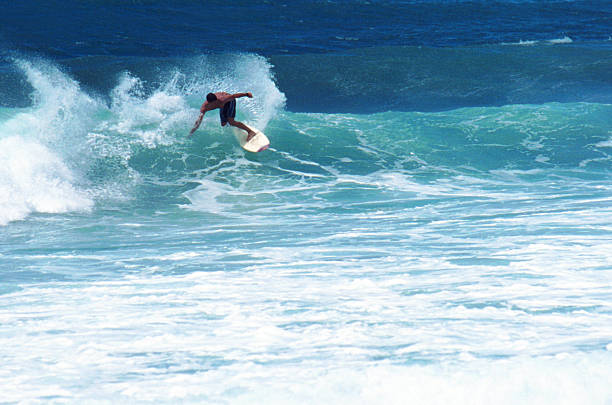
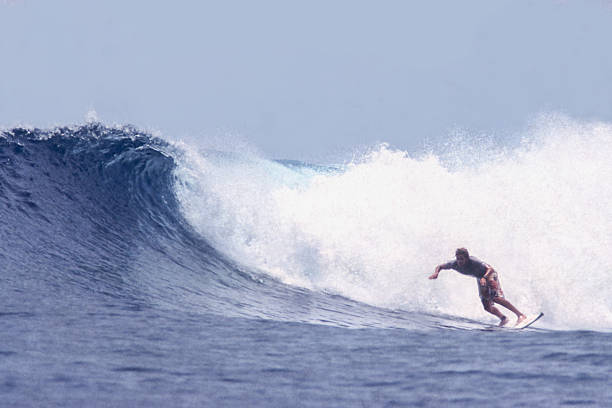
There are certain phrases that carry the weight of an entire ocean. In the lineup at Waimea Bay, when the northwest swell is pulsing and the sets are jacking up double overhead, you might hear an old salt mutter it under his breath before scratching for a bomb. Or you might see it stitched onto a trucker hat or spray-painted on a board bag. Three words that have become the heartbeat of big wave surfing: Eddie Would Go. It’s not just a slogan. It’s a philosophy, a way of life handed down from a man who never let fear keep him from paddling out when others were paddling in. Eddie Aikau, the first lifeguard at Waimea Bay, didn’t just ride waves; he rode into the teeth of danger with a calm that baffled everyone who watched him.
Eddie was born in 1946 in Kahului, Maui, and from the moment he first stood on a surfboard, the ocean recognized him as one of its own. He grew up in a surfing culture that was still pure, where the line between waterman and wave rider blurred into one seamless identity. By the time he took the lifeguard job at Waimea in 1971, the Bay was known as a graveyard for even the most experienced surfers. Waves there don’t just break; they detonate on the reef, swallowing everything in their path. But Eddie treated the Bay like a playground. He rescued hundreds of swimmers and surfers over the years, often flying down the face of a twenty-footer to pluck someone from the foam. His peers say he never hesitated. If someone was in trouble, Eddie would paddle straight into the impact zone, no matter how gnarly the swell. That’s where the mantra was born. When people saw a dangerous situation and asked what to do, the answer was simple: Eddie would go.
This spirit reached its most legendary expression during the 1978 voyage of the Hōkūleʻa, a traditional Polynesian canoe that set out to retrace the ancient migration routes across the Pacific. Eddie was a crew member, a nod to his deep heritage as a Hawaiian waterman. The canoe capsized in a storm about twenty miles off Molokai, leaving the crew stranded in choppy, shark-infested waters. While others prayed and waited, Eddie did what he always did. He grabbed his surfboard, said he was going for help, and paddled off into the darkness. It was a desperate move, but the ones who knew him best understood it wasn’t reckless. It was simply Eddie’s nature to act when action was needed. He was never found, but his sacrifice ignited a fire in the Hawaiian community. The search for him became one of the largest in state history, and though his body never surfaced, his legacy grew deeper than any reef.
The Eddie Aikau Big Wave Invitational was born from that legacy. Held at Waimea Bay, it’s not a contest you can schedule. It waits until the ocean decides to roar with waves consistently over twenty feet, faces so sheer they look like moving cliffs. Surfers from around the world come to honor a man who never entered a contest for fame or prize money. The event is about soul. It’s about showing up when the conditions are terrifying and riding with the knowledge that you are connected to something bigger than a scorecard. The trophy is a bronze statue of Eddie himself, and the winner gets something rarer than a check: the recognition that they carried his torch through the foam.
But the deepest takeaway from Eddie’s story isn’t about winning a trophy or charging the biggest wave of your life. It’s about the everyday choice to act with courage and compassion. In the surf world, we talk about getting barreled, about shredding, about the perfect tube ride. Those are stoke-filled moments, for sure. But Eddie represents something else. He represents the moment when you see a grom struggling in a rip, or a friend pinned on the inside after a bad wipeout, and you turn your board around instead of paddling for the shoulder. He is the reminder that surfing, at its core, is not just a sport. It’s a community bound by an unspoken code of looking out for each other. When the wind howls and the waves stand up like moving mountains, the question isn’t whether you can make the drop. The question is whether you would paddle out for someone who needs you. And the answer, for those who truly understand, echoes across the decades.
So next time you pull on your wetsuit at dawn and see a swell line on the horizon, think about Eddie. Think about the calm he carried, the faith he had in his own strength, and the love he held for the ocean and the people in it. That’s the real legacy. Not just the big wave invitational or the T-shirts or the hashtags. It’s the quiet, radical act of showing up, even when the ocean is angry, even when you’re scared, even when the easy choice is to stay on the sand. Eddie would go. And because of him, a little bit of that courage lives in every surfer who drops into a wave bigger than they feel ready for, and every soul who decides that helping a fellow human is worth the risk. That’s the endless summer of the heart – warm, unstoppable, and forever willing to paddle out.